How to Read Your Paycheck (What All Those Deductions Mean)
Have you ever looked at your paycheck and wondered:
“Where did all my money go?”
You aren’t alone.
A paycheck can contain dozens of different numbers, abbreviations, deductions, and tax categories. Your gross pay might look significantly larger than the amount that actually hits your bank account, and understanding the difference can help you make better financial decisions.
Your paycheck isn’t just telling you how much you earned. It’s also showing you where your money went before it reached your checking account.
Let’s break it down.
Start With Gross Pay
The easiest place to start is the top.
Gross pay is generally the amount you earned before deductions and withholdings.
If you earn $75,000 per year and are paid biweekly, your regular gross paycheck would be approximately:
$75,000 ÷ 26 = $2,884.62
However, that $2,884.62 won’t be what you’ll receive in your bank account.
Your employer may then subtract taxes, insurance premiums, retirement contributions, HSA contributions, and other deductions.
What remains is your net pay, or take-home pay.
In its simplest form:
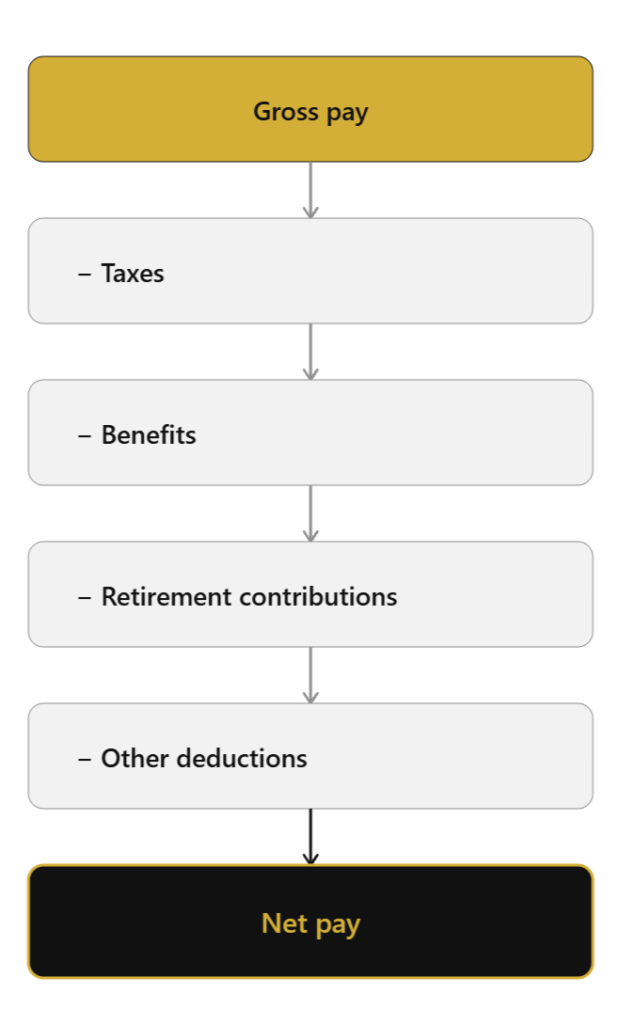
Understanding each of those categories is where things get interesting.
Federal Income Tax Withholding
One of the largest deductions for many employees is federal income tax withholding.
Your employer generally withholds federal income tax from your paycheck and sends it to the IRS on your behalf. The federal income tax system operates largely on a pay-as-you-go basis, meaning taxes are generally paid throughout the year rather than waiting until you file your tax return.
How much is withheld depends on factors such as your wages, dependents, other credits, other income that causes extra withholding, or other deductions that reduce extra withholding. All this information is provided on the Form W-4 that you will fill out when you start employment, but you can change it at any point during the year.
One important distinction:
Withholding is not necessarily the same thing as your actual tax liability.
Your employer is essentially making payments toward your eventual tax bill.
When you file your tax return, your actual tax liability is calculated and compared with what you’ve already paid through withholding and other payments.
If you paid too much, you may receive a refund.
If you paid too little, you may owe additional tax.
This is why a large tax refund doesn’t necessarily mean you “won” at tax time—it may simply mean you gave the government more money throughout the year than was ultimately necessary.
State Income Tax
Depending on where you live and work, you may also see state income tax withholding on your paycheck.
The concept is similar to federal withholding: your employer withholds money from your paycheck and remits it to your state on your behalf.
Not every state has an individual income tax, and the rules vary significantly between states.
If you move, work in multiple states, or have income from another state, your state withholding can become considerably more complicated.
Social Security and Medicare Taxes
You’ll also likely see deductions for Social Security and Medicare.
These are commonly referred to as FICA taxes.
For employees, Social Security tax is generally 6.2% of covered wages up to the applicable annual wage base, while Medicare tax is generally 1.45% of wages. Higher-income employees may also be subject to an additional Medicare tax.
Unlike federal income tax withholding, these taxes generally aren’t adjusted based on your deductions, credits, or filing status in the same way federal income tax is.
You may therefore see something like:
Social Security: $178.85
Medicare: $ 41.83
on a $2,884.62 paycheck, depending on the applicable wage and tax rules.
These taxes help fund Social Security and Medicare programs.
Pre-Tax vs. Post-Tax Deductions
This is one of the most important concepts to understand when reading a paycheck.
Not every deduction is treated the same way for tax purposes.
Some deductions are made before certain taxes are calculated, while others are taken out after taxes have already been calculated.
That’s where the terms pre-tax and post-tax come into play.
Pre-Tax Deductions
A pre-tax deduction generally reduces the amount of income subject to certain taxes.
Common examples may include:
- Traditional 401(k) contributions
- Traditional 403(b) contributions
- Certain health insurance premiums
- HSA contributions made through an eligible payroll arrangement
- Certain flexible spending account contributions
For example, suppose you earn $3,000 and contribute $300 to a traditional 401(k).
You may not necessarily be paying federal income tax on the full $3,000 of wages for that paycheck.
The exact tax treatment depends on the particular benefit and tax involved. For example, traditional retirement contributions generally reduce federal taxable wages but can still be subject to Social Security and Medicare taxes.
This is one reason understanding the words pre-tax and post-tax matters.
Post-Tax Deductions
As the name implies, post-tax deductions generally come out after the applicable taxes have been calculated.
A Roth 401(k) contribution is a common example.
You contribute money that is subject to current income tax, but qualified withdrawals in retirement are generally tax-free.
This means a Roth contribution can reduce your take-home pay without reducing your current federal taxable wages in the same way a traditional 401(k) contribution does.
Neither approach is automatically better. They simply provide different tax treatment.
Let’s look at some common pre-tax and post-tax deductions.
Health Insurance
Health insurance premiums are a common paycheck deduction.
If your employer provides health insurance, you may pay part of the premium through payroll deductions.
This may show up as: Health Insurance: −$150.00
Depending on your employer’s plan and how much of the cost they pay versus each employee pays, the amount may differ; however, the concept still applies. The $150 deduction goes toward your health insurance plan.
Depending on how the employer’s plan is structured, health insurance premiums may be deducted on a pre-tax basis.
This is another reason two employees earning exactly the same salary can have very different take-home pay since the type of health insurance plan and the amount they pay toward it could differ dramatically between employers.
HSA Contributions
If you have a qualifying high-deductible health plan, you may also see an HSA contribution on your paycheck.
Health Savings Accounts can be particularly valuable because eligible contributions made through a qualifying employer payroll arrangement can receive favorable federal tax treatment. Employer and qualifying salary-reduction HSA contributions can generally be excluded from federal income tax withholding and Social Security and Medicare taxes.
This may show up as: HSA Contribution: –$200
That $200 isn’t simply disappearing. It’s being redirected from your paycheck into your HSA. While technically, you don’t see this directly hit you bank account, you can then use the HSA for qualified medical expenses, subject to the applicable rules. In a way, it’s part of your take-home pay; it’s just limited in how it can be spent.
Retirement Contributions
Your paycheck may also show contributions to an employer retirement plan.
Common examples include:
- 401(k)
- Roth 401(k)
- 403(b)
- 457(b)
- SIMPLE IRA
- SEP IRA for certain self-employed individuals and businesses
The exact treatment depends on the type of account.
For example, a traditional 401(k) contribution generally receives its tax benefit today, while a Roth 401(k) contribution generally receives its tax benefit later through potentially tax-free qualified withdrawals.
Your paycheck may therefore show something like:
401(k): –$200
or
Roth 401(k): –$200
Similar to the HSA, that $200 is not necessarily a cost in the traditional sense. It’s money that again restricted until you reach a qualifying distribution age if you want to avoid penalties.
Other Insurance
You may also have deductions for other types of insurance, such as:
- Life insurance
- Disability insurance
- Accident insurance
- Hospital indemnity insurance
- Supplemental coverage
The tax treatment varies depending on the particular benefit and how your employer structures the plan.
Again, these are not necessarily taxes and may not have any tax benefits, but they are items that employers can and sometimes do offer.
Charitable Contributions
Some employers allow employees to make charitable contributions through payroll deductions.
For example: United Way Contribution: –$25
That money is being withheld from your paycheck and directed toward the charitable organization or program you’ve selected. Depending on the arrangement and current tax rules, the contribution may or may not receive a particular tax benefit.
The important thing is recognizing that it is a voluntary deduction.
Garnishments and Other Mandatory Deductions
Some paycheck deductions aren’t voluntary.
These can include things such as:
- Child support
- Tax levies
- Court-ordered garnishments
- Certain other legal obligations
These deductions can be particularly confusing because they may appear alongside voluntary benefits and tax withholdings.
If you see a deduction you don’t recognize and want further information, you can always ask your employer’s payroll or human resources department what it represents.
The bottom line is don’t assume every line on your paycheck is a tax.
What About Self-Employed Individuals?
If you’re self-employed, your “paycheck” can look very different—or you may not have a traditional paycheck at all.
Instead of an employer withholding federal income tax, Social Security, and Medicare taxes for you, you’re generally responsible for managing those obligations yourself.
Self-employed individuals generally calculate self-employment tax, which consists primarily of Social Security and Medicare taxes. The current self-employment tax rate is generally 15.3%, subject to the applicable rules and limitations.
This is one reason self-employed individuals frequently need to make estimated tax payments throughout the year.
Self-employed individuals may also have access to different retirement plans and may qualify for certain deductions, including a potential deduction for qualifying self-employed health insurance premiums.
So while a traditional employee might see taxes automatically withheld from each paycheck, a self-employed individual often needs to create their own system for setting money aside.
Additionally, many self-employed individuals pay for their own health insurance. While this may not be shown on the pay stub, it will typically be shown on the W-2. I add this as a note that if you are paying yourself a wage and you pay health insurance, make sure you or whoever files your payroll tax filings knows, so that they can get the self-employed health insurance added.
Why Your Take-Home Pay Matters
One of the biggest mistakes people make when evaluating a job offer is looking only at the salary.
Suppose Job A pays: $80,000 salary
and Job B pays: $75,000 salary + excellent health insurance + 5% 401(k) match + HSA contribution
Which job is better?
You can’t necessarily answer that by looking at salary alone.
Benefits can have significant value.
Likewise, two people earning $75,000 can have dramatically different take-home pay depending on:
- Health insurance
- Retirement contributions
- HSA contributions
- Tax withholding
- Filing status
- Other payroll deductions
- Location
- Voluntary benefits
Your paycheck gives you a much better picture of how your compensation is actually being allocated.
Don’t Just Look at Your Paycheck—Read It
Your paycheck is more than a number showing how much money you can spend.
It is a snapshot of your financial decisions.
If you’re contributing 10% to your 401(k), funding an HSA, paying for health insurance, and having taxes withheld, your take-home pay may look substantially smaller than your gross salary.
That doesn’t necessarily mean you’re doing something wrong. It may mean you’re directing a significant portion of your compensation toward taxes, insurance, and your future.
The key is understanding where the money is going.
My Two Cents
You don’t need to become a payroll expert to understand your paycheck.
Start with four numbers:
Gross Pay → Taxes → Deductions → Net Pay
Then take a few minutes to understand each line in between.
Knowing what is being withheld, what is being saved, what is paying for benefits, and what is actually reaching your bank account can make it much easier to evaluate your financial situation.
And if something doesn’t make sense?
Ask. Your payroll department, HR department, or tax professional can help explain deductions you don’t understand.
The more you understand about your paycheck, the easier it becomes to understand where your money is actually going—and that’s a pretty important first step in managing it.
– Brendan Tiedeman, CPA, CVA
Disclaimer:
This article is for educational and informational purposes only and should not be considered tax, legal, investment, or financial advice. Payroll and tax rules vary depending on individual circumstances, employer benefit plans, and applicable federal, state, and local laws. Tax laws change frequently, and readers should consult with a qualified tax professional regarding their specific circumstances before making financial decisions.